Business process redesign
Business process redesign, with AI agents in the loop
Every serious redesign starts with a faithful map of today and ends with a defensible plan for tomorrow. What changed in the AI era is the middle: for each step, there is now a third option between "a person does it" and "the system does it". The redesign question became an allocation question.
As-is first, always
The as-is is where redesigns are won. Volumes, minutes per run, systems touched, pain points: these numbers decide which steps are worth giving to an agent and which are not. Describe the process, draw it, or let the interview mode extract it from your team; the map lands on a canvas where every step already carries the data the business case will need.
The to-be is an allocation, not a diagram
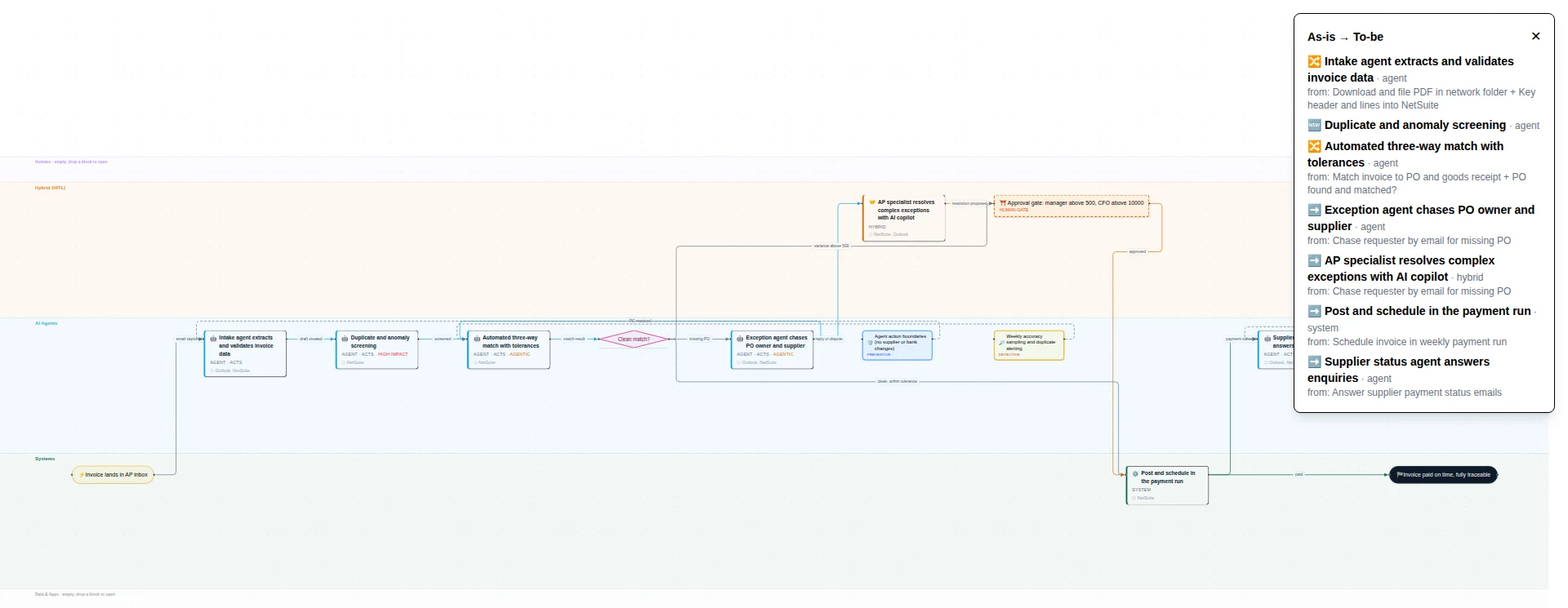
The AI consultant proposes the redesign: which steps migrate to agents (and why), which become hybrid, which consolidate, where gates and controls go. The Diff panel lists every change against the as-is, so the room debates specifics instead of vibes. Nothing is final: drag a step back to the Humans lane and the design, the governance findings and the numbers update with it.
Governed, priced, delivered
Before anyone builds anything, the governance check reads the design: agents deciding without accountability, high-risk steps without supervision, missing human gates on consequential actions. The business case prices the whole thing in your currency with payback by month. And the delivery plan turns blueprints into tasks with owners. Redesign, defended end to end. For the underlying concepts, see agentic workflows; for the mapping itself, AI process mapping.