Process mapping software
Process mapping software built for the AI era
Most process mapping software was designed to document work that only humans do. It gives you shapes, swimlanes named after departments, and an export. In a world where part of your process is about to be executed by AI agents, the mapping tool has to answer a different question: who, or what, should execute each step, and under what supervision?
Where classic mapping tools stop
- Diagrams, not decisions. A drawing of the process says nothing about which steps are candidates for agents, what that would cost, or what could go wrong.
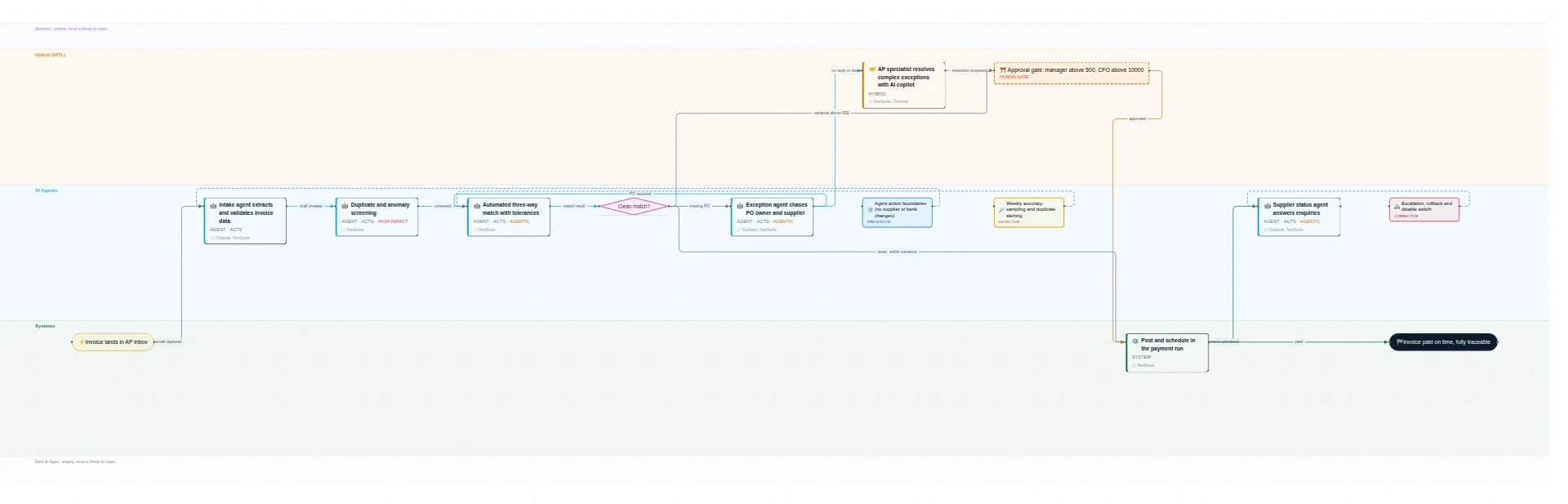
- Departments, not executors. Swimlanes by team hide the question that matters now. Lanes here are by executor: Humans, Hybrid, AI Agents, Systems, Data.
- No governance. Classic tools cannot tell you that an autonomous agent is making a customer-facing decision with nobody accountable. The built-in governance check can, across five perspectives: decision, data, ethical, regulatory and model structure.
- No numbers. The business case engine prices agent steps with live model prices per million tokens and compares them with the human hours they replace, down to the payback month.
What a map looks like here
One canvas, two views. The as-is maps today's reality. The to-be is the agentic redesign, generated by the AI consultant or drawn by you, and the Diff panel lists every step that was migrated, consolidated or newly created. From there, every step opens into a build-ready blueprint and a delivery board with owners and due dates. If you are starting from a blank page, AI process mapping generates the first draft from a plain-language description.