Agentic workflows
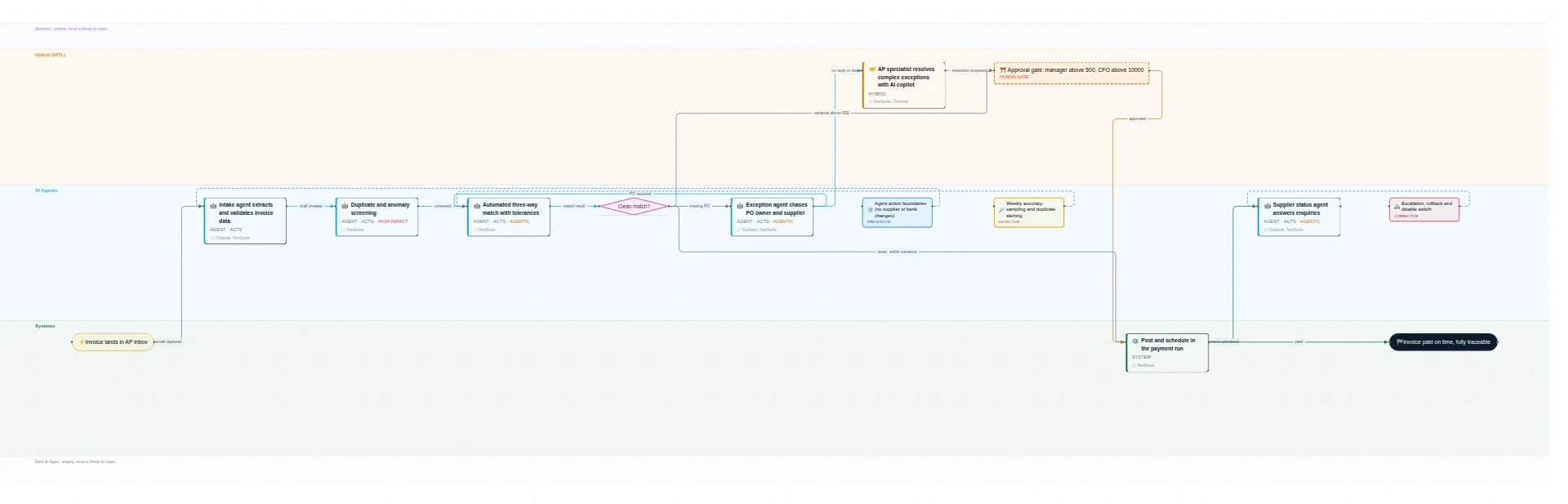
Agentic workflows, explained on one canvas
An agentic workflow is a process where AI agents execute real steps: reading documents, classifying cases, chasing missing information, preparing payments, drafting communication. The hard part is not the technology. It is deciding which steps, with how much autonomy, under whose supervision. That is a design problem, and it deserves a design tool.
The three levels of autonomy
- Informs. The agent prepares information; a human acts. Lowest risk, first step for most teams.
- Recommends. The agent proposes the decision; a human approves or corrects it. The workhorse of serious deployments.
- Acts. The agent executes end-to-end and reports. Reserved for steps where impact is bounded and controls are in place.
Autonomy is a dial, not a badge. The same claims-triage agent can act on low-value claims and merely recommend on complex ones, with a decision block routing between the two. On the canvas, that rule is visible to everyone.
Humans in the loop, by design
Hybrid steps put a person and an agent on the same task. Human gates stop the flow before consequential actions: a payment, a customer communication, a hire. Controls, preventive, detective and corrective, supervise agents continuously: confidence thresholds before, sampling and drift alerts during, reconciliation and rollback after. A risk matrix (impact × likelihood) tells you where supervision is mandatory rather than optional.
Designing one, step by step
Start with the as-is: who does what today, in which systems, at what volumes. Then reallocate: move steps to the AI Agents lane deliberately, one at a time, setting autonomy and supervision as you go. Validate the design against governance rules, price it against the hours it frees, and break each agent step into a build-ready blueprint. The tools for each of these stages are described in AI process mapping and business process redesign.