aiprocess.design Open the studio

AI SOP generator

Operating procedures your team can actually build from

Generic AI SOP tools write plausible documents from a one-line prompt, and the result reads like it: right shape, wrong details. Here, every procedure is generated from a step that lives inside your process design, so the AI writes with the step's real context: which systems it touches, what feeds it, what it hands off to, and which controls supervise it.

Grounded beats generic

When the generator writes the blueprint for an intake agent, it knows the step runs 600 times a month across ClaimsCore, PolicyDB and Outlook, that a preventive control caps its access, and that a triage agent consumes its output. The instructions that come back name those systems, set concrete confidence thresholds, and route exceptions to the humans who exist in the design. That is the difference between an SOP and a wish.

Four phases, one standard

Every blueprint follows the same operational skeleton: 🔧 Setup (identities, accesses, test sets), ▶ Execution flow (the numbered runtime sequence), ⚠ Exceptions (thresholds, escalation, fallback), 📬 Handoff (what is delivered, to whom). Copy it as text into your documentation, export it in the PDF annex, or push the setup tasks straight to the delivery board with owners and due dates.

The blueprints inherit their guardrails from the design's governance framework, so procedure and policy never drift apart.
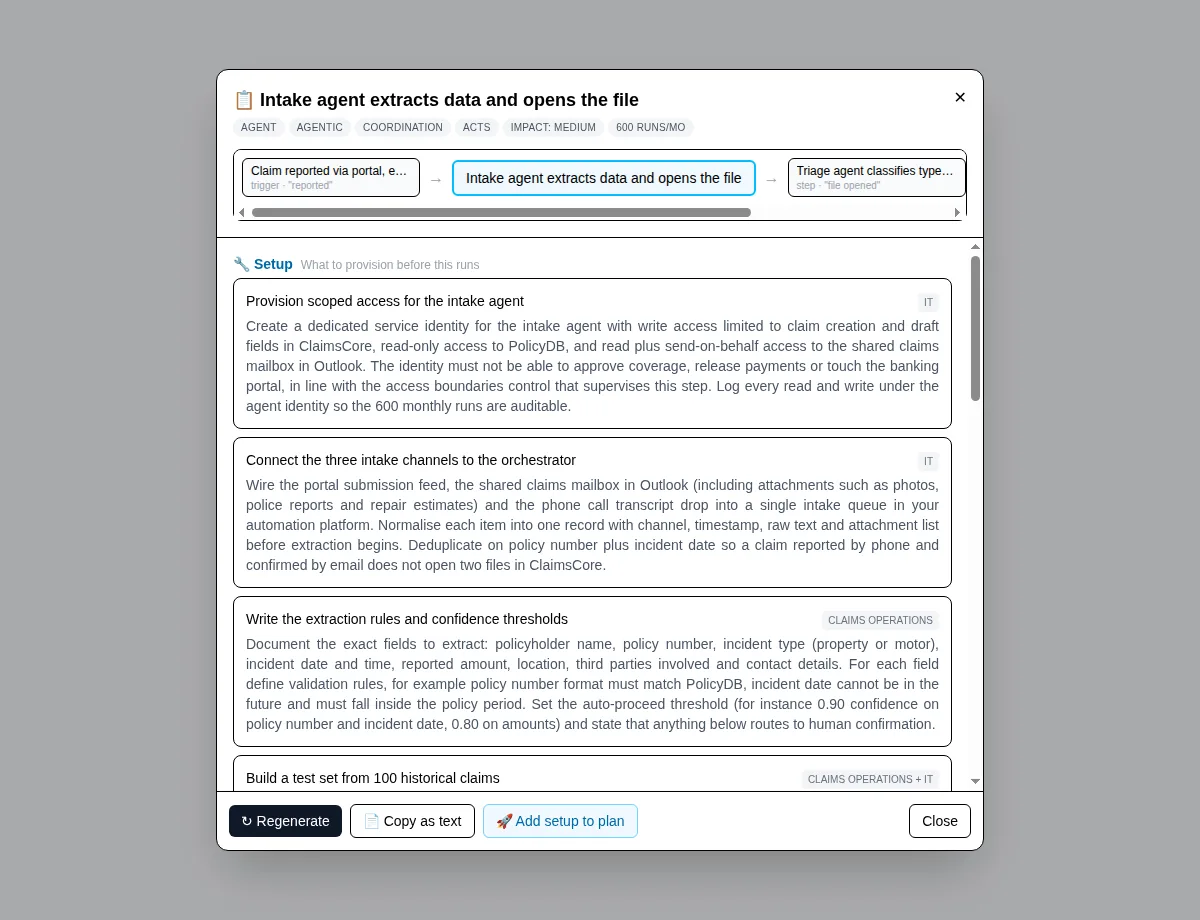
a generated blueprint for an intake agent with setup tasks naming real systems and thresholds
A real generated blueprint: scoped access, intake channels, extraction rules, test set. Ready to assign.

Frequently asked questions

What is an AI SOP generator?

A tool that turns process knowledge into standard operating procedures using AI. The difference here: instead of generating a generic document from a prompt, each SOP is generated from a step of your actual process design, so it inherits the step's systems, thresholds, supervising controls and neighbours in the flow.

What structure do the generated procedures follow?

Four phases. Setup: accesses, identities, data sources and test sets to provision. Execution flow: the exact numbered runtime sequence, naming systems and decision criteria. Exceptions: thresholds, escalation paths and fallbacks. Handoff: what leaves the step and to whom. Detailed enough to build from, without naming any specific automation platform.

Do they work for human steps too?

Yes. For human steps the blueprint reads like practical craft: checklists, criteria, templates to prepare and cadences, grounded in your process context rather than generic advice.

How do SOPs become execution?

One click sends a blueprint's setup phase to the delivery board as tasks, with the step name attached. Assign owners and due dates, track them through To do, In progress and Done, and export the executive PDF with the implementation plan included.

Generate the blueprint for one real step

The studio is in private preview. Open it to request access, or walk through a real, read-only example first.